
Execution Is the Management of Freedom of Action
Why strategy only survives contact with reality when you design for freedom of action, not tighter control
Most strategies do not fail because they are wrong (you can argue about the quality of the strategy itself, but that is for another day). It fails because organisations do not understand what execution actually is. They treat execution as delivery, as rollout, as the point at which a plan is translated into tasks and milestones and then monitored for compliance. When execution disappoints, the diagnosis is almost always the same: poor alignment, weak accountability, insufficient grip.
So leaders add more governance, more reporting, more detail, more oversight. The organisation becomes busier and less effective at the same time. This is not a failure of discipline. It is a misunderstanding of execution itself.
Execution, in any environment that is even mildly turbulent, is the ongoing management of freedom of action. Strategy only survives contact with reality when people throughout the organisation can actually move, not just understand the plan. Execution is about preserving the organisation’s ability to respond intelligently as reality changes, without waiting for permission, escalation or re‑planning.
Freedom of action is the room people have to act in line with intent, within understood constraints, using their capability, without waiting for permission. It rests on three elements that must be treated as a single design problem: intent, constraints and capability. Most organisations treat these separately, and in practice, execution collapses when they are not designed as a single system.
Why do plans break the moment they meet reality?
Stephen Bungay's work on The Art of Action helps explain why execution problems persist even in competent organisations. He identifies three gaps that cannot be closed by better planning.
The knowledge gap exists because leaders never have enough information to accurately predict outcomes in a complex environment; no amount of analysis can remove it. The world will always surprise you. The alignment gap exists because even when the direction is agreed upon, people still interpret it differently as they act in different contexts under different pressures. The effects gap exists because actions do not produce outcomes in a linear or fully predictable way; the environment responds, sometimes in ways that neutralise or reverse what you intended.
Most organisations respond to these gaps by doubling down on planning and control. They try to eliminate uncertainty, tighten alignment and specify actions more precisely, which feels responsible but makes execution more brittle. The alternative is not to abandon planning, but to stop confusing plans with execution. Execution is not the elimination of these gaps. It is learning to operate within them.
There is also a systemic reason this brittleness keeps appearing. Ashby’s Law of Requisite Variety states that only variety can absorb variety: a control system must be at least as flexible and responsive as the environment it seeks to manage. If your environment is complex, fast‑moving and unpredictable, and your control system is rigid, centralised and slow, the centre cannot process enough information fast enough to match the speed of reality at the edge. Pushing more decisions upwards in a complex context violates that law and guarantees that execution will lag events.
Execution is not decentralisation.
This is where the decentralisation debate usually goes wrong. Decentralisation is treated as a structural choice: centralised versus decentralised, top‑down versus bottom‑up, autonomy versus control. That framing misses the point.
Execution is not about where decisions sit on an org chart. It is about whether people can act coherently when conditions change. In reality, every organisation is already decentralised at the point where reality intrudes, because decisions are being made all the time, often informally, defensively and in ways leaders never see. The question is not whether decisions are decentralised, but whether they are directionally aligned and contextually intelligent.
That depends on freedom of action. Mission Command doctrine describes a pattern where disciplined initiative is expected at every level, within a clear commander’s intent and defined boundaries. The same pattern applies in organisations: the goal is directional coherence under constraint, not free‑for‑all autonomy or rigid central control.
Alignment that is not backed by real freedom of action is performance theatre. Alignment that is built on freedom of action is intent made real, because people can actually do something useful when the situation shifts.
Freedom of action is not the absence of constraint.
This is the critical distinction that most empowerment narratives ignore. Freedom of action does not mean people can do whatever they want. It means they can act appropriately at speed without waiting for instruction when the situation demands it.
Freedom of action is shaped by three elements that need to be designed together:
Intent: what matters now, and why.
Constraints: what must be protected, avoided or escalated.
Capability: the knowledge, skills and experience to exercise judgement under pressure.
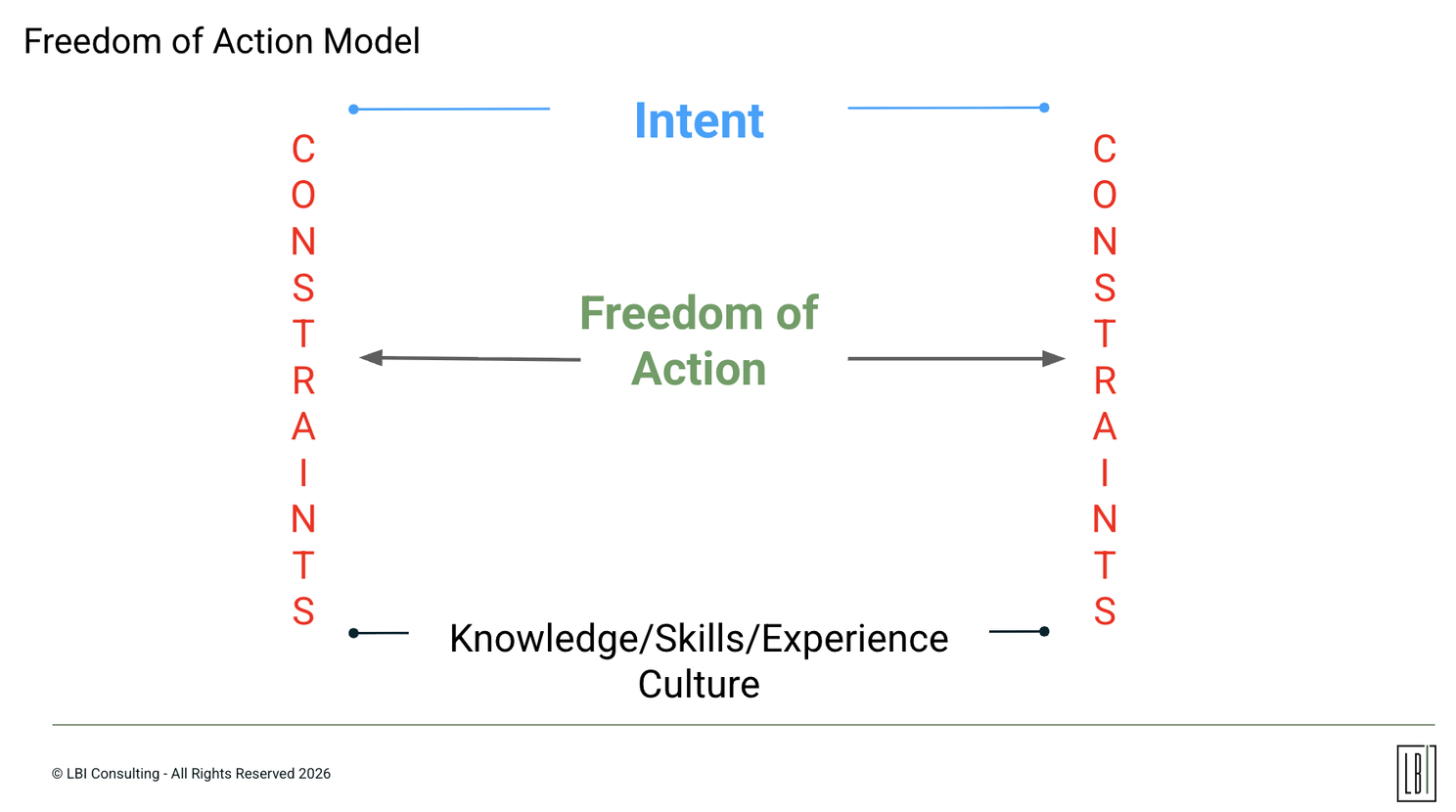
Freedom of Action Model
Remove any one of these, and execution degrades. If intent is vague, freedom turns into drift, because people improvise around different assumptions about what really matters. If constraints are unclear or incoherent, freedom turns into risk or paralysis, because people either over‑reach or freeze to avoid blame. If capability is insufficient, freedom becomes error, and leaders respond by pulling control back to the centre, further reducing learning and initiative.
This is why empowerment programmes so often fail. They talk about trust and autonomy while ignoring constraints and capability. People are told they are empowered, but the organisation punishes them the moment they act outside the script, so execution becomes performative rather than adaptive. A viable organisation is one in which each operational unit has sufficient freedom of action to respond to its environment, while coherence is maintained through structures that coordinate, support and constrain that action. The Freedom of Action model makes that viability explicit at the level of individual judgement by specifying intent, constraints and competence as the ingredients of real autonomy.
Intent is not vision. It is a decision filter.
Most organisations overload intent. They confuse it with vision statements, purpose narratives, strategic themes and values; these may be meaningful, but they are not operational intent. Operational intent answers a simpler and more demanding question: given what we can see now, what takes precedence, and what trade‑offs are we willing to make?
In Mission Command, the commander’s intent clarifies the purpose of an operation and the desired end state without prescribing the method, allowing subordinates to adapt their actions as conditions change. Good intent reduces the knowledge gap without pretending it can be closed; it does not try to predict outcomes, it gives people a way to choose when prediction fails.
That means intent must be tight, not expansive. It must both exclude and include, so people can say “not this, not now” with confidence. It must be revisited as conditions change; otherwise, yesterday’s intent becomes today’s constraint, locking the organisation into outdated priorities. Much execution failure labelled as “lack of alignment” is actually intent drift: people are still acting in line with an intent that no longer fits reality, because no one has formally replaced it.
Constraints are how leaders stay in control without deciding everything.
Constraints are not rules for their own sake. They are how leaders shape the decision space without occupying it. Mission Command principles emphasise disciplined initiative and prudent risk, which depend on clear boundaries around what is unacceptable and what can be traded for advantage.
Well‑designed constraints tell people:
Which risks are unacceptable?
Which values or assets must not be traded away?
Which decisions must be escalated and why?
Where judgment is expected rather than compliance.
In volatile conditions, constraints matter more, not less, because they allow people to move quickly without constantly guessing what will get them into trouble later. Without them, people either freeze or act defensively, optimising to avoid blame instead of maximising impact.
Critically, constraints should change as capability develops. If people do not yet have the experience to make safe decisions, you tighten constraints while you build capability; that is not control, it is stewardship. Most organisations do the opposite: they loosen constraints rhetorically, then tighten them informally through approvals, reviews and senior interventions when things feel uncomfortable, which teaches people that autonomy is temporary and permission is safer.
Capability is the silent limiter of execution.
Freedom of action exposes capability gaps. That is its purpose. If people lack the experience to make decisions under pressure, the answer is not to permanently re-centralise decision-making, but to create conditions where judgement can be developed safely.
Military and high‑reliability organisations do this through rehearsal, realistic training, and disciplined after‑action reviews, where decisions are debriefed, irrespective of outcome, to extract learning. In civilian organisations, this often degenerates into slide‑driven “lessons learned” sessions that do not change actual behaviour. Execution capability is built through exposure and feedback in real or realistic situations, not through cascading slide decks.
Organisations that do not deliberately design this end up with a small group that can operate under uncertainty and a large group that waits for instruction. Ashby’s Law then bites again: the organisation’s effective variety is limited to a handful of people at the centre, which is far too little to cope with the variety of the environment.
How the control reflex destroys freedom of action
When execution fails, most organisations react in exactly the wrong way. They centralise decisions, tighten controls, add governance and reduce discretion at the edge, all in the name of control, assurance and accountability. This control reflex systematically destroys the organisation’s freedom of action at the moment it is most needed.
Execution failure is usually misread as a discipline problem: people did not follow the plan, teams were misaligned, and accountabilities were unclear. This diagnosis naturally leads to stronger incentives, tighter oversight, and more frequent reviews, treating execution as a compliance problem. In uncertain environments, execution rarely fails because people are unwilling to act; it fails because people cannot act intelligently without taking unacceptable personal or organisational risk.
The more uncertain the environment becomes, the more anxious senior leaders feel about losing grip, especially under board, regulatory and media scrutiny. When execution starts to wobble, they reach for familiar and defensible tools: more layers, more detail, more central approvals. This creates a powerful illusion of control, with more meetings, dashboards and documents, but it removes the organisation’s ability to respond to reality faster than the centre can process it.
The paradox is that the more leaders try to control decisions centrally, the less control they actually have over outcomes, because reality does not wait for governance cycles. The crucial moments often occur far from the centre, under time pressure and with incomplete information, and if people there cannot act within intent and constraint, the organisation forfeits its ability to shape events.
Merging the three: how execution actually works
When intent, constraints and capability are treated as a single design problem, something changes. The knowledge gap is managed because intent gives people a way to act without full information, instead of waiting for perfect certainty. The alignment gap narrows because constraints and backbriefs force intent to be interpreted rather than just received, which exposes misunderstandings early. The effects gap becomes visible when action is reviewed against outcomes and learning, rather than just plan adherence, allowing the organisation to update its orientation.
Execution becomes a cycle of orientation, action and adjustment rather than a linear march through a plan. The organisation stops trying to predict and control every outcome, and instead creates enough local variety and feedback for teams to adapt as conditions change. This is observable in organisations that operate in genuinely turbulent markets, heavily regulated environments and large incumbents under real competitive pressure.
These organisations do not eliminate uncertainty. They build the capacity to move within it. That capacity is what this article calls freedom of action: the designed ability of people throughout the organisation to act in line with intent, within clear constraints, at a level of risk their capability can carry.
A hard test for leaders
If you want a practical test of whether execution in your organisation is real or performative, ask yourself this: when reality changes quickly, how many people can act in line with intent, within understood constraints, using their judgement, without waiting for permission. If the answer is “very few”, the issue is not motivation or accountability. It is an execution design.
Until intent is tight, constraints are explicit and capability is built deliberately, strategy will continue to look good on paper and fail in practice. Execution is not about making people comply with plans. It is about maintaining freedom of action when plans stop working, so your strategy has a chance of surviving contact with reality.
