

Insights on Strategy, Execution & Complex Organisations
I write about how strategy, execution and organisational design work in real-world environments — the kind that resist simple plans, reward systems thinking, and require leaders to adapt with clarity and purpose. Here you’ll find insights on strategic ambiguity, strategic manoeuvre, organisational viability, decision-making in complexity, and practical leadership thinking.
Browse the latest articles, or explore by topic below.

The plan is nothing, planning is everything
The value isn't in the plan. It's in how you prepare to adapt.
There's a military adage that's made its way into business circles: "No plan survives first contact." Eisenhower sharpened it further: "The plan is nothing; planning is everything."
But most organisations still treat planning as if the goal is to lock everything down. Define every milestone. Predict every variable. Control every outcome.
And then they are surprised when it falls apart.

Aspiration After Observation: Why Strategy Starts with Seeing, Not Saying
Too often, purpose is treated as something you declare, design, and disseminate. It's written on the walls, embedded into decks, and broadcast at town halls. But when leaders treat purpose as real simply because it's been said, they mistake narrative for reality, and control for coherence.
Here’s the uncomfortable truth: It doesn’t matter what you say your organisation exists to do. It matters what your organisation actually does.
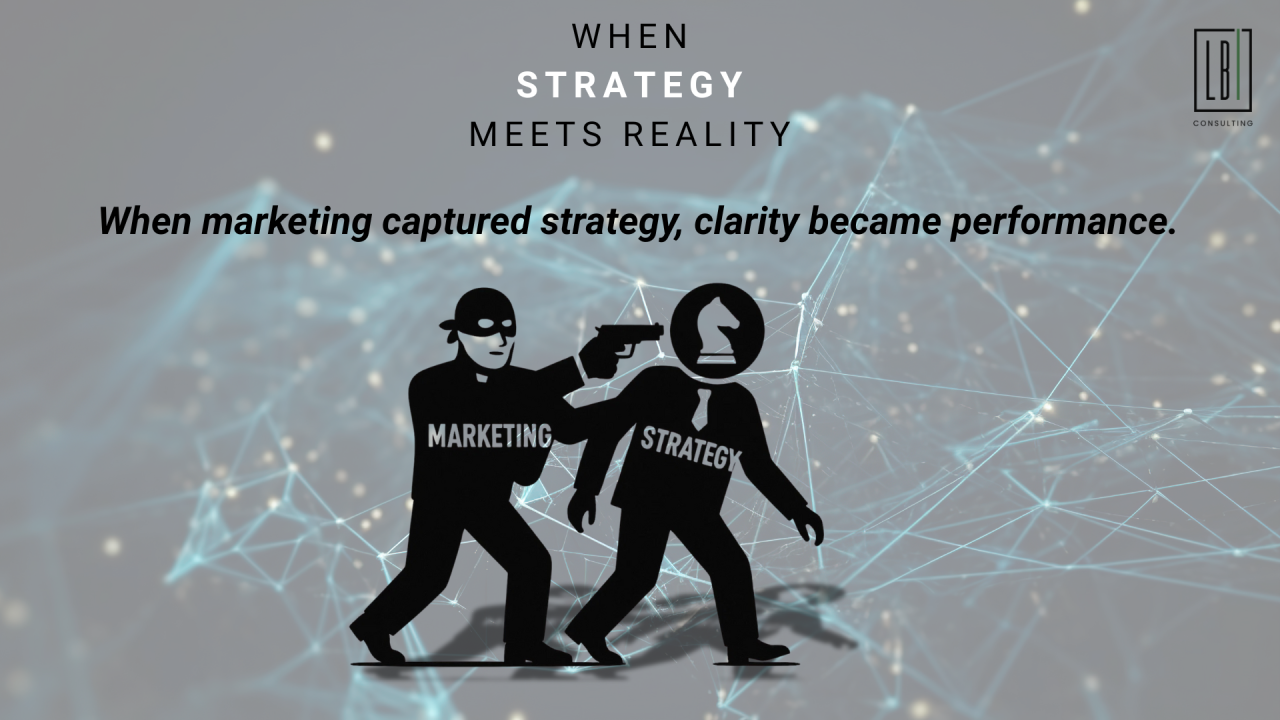
How Marketing Hijacked Strategy
Why buzzwords don't bring clarity — and what strategy actually demands
When marketing captured strategy, we didn't just reframe the message. We reframed the work.
Strategy became something to be cascaded rather than constructed. It became a narrative exercise. A brand asset. A motivational toolkit for internal engagement.
In that shift, we lost something fundamental: the connection between strategic intent and structural capability.
We were sold the lie that strategy starts with "why." The key to coherence was a compelling narrative.
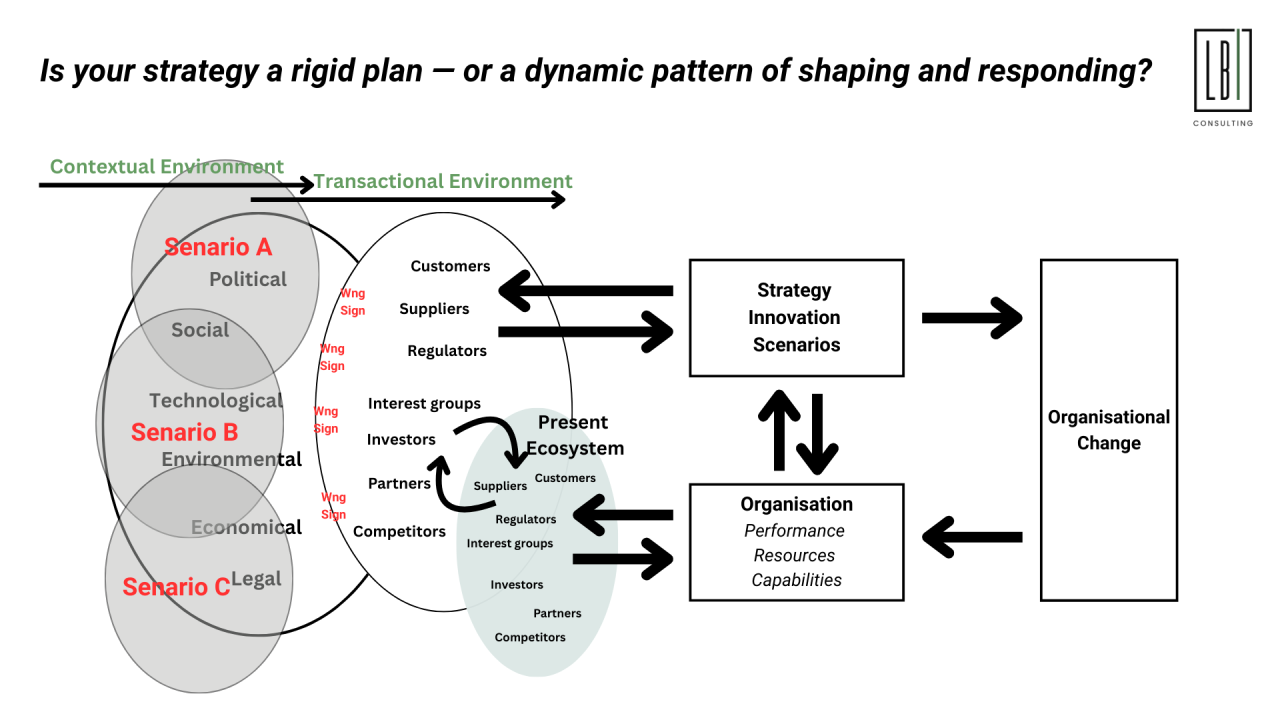
Strategy is not a fixed aspiration.
Rethinking aspirations, planning cycles, and the complexity we're actually in.
We must move on from the idea that strategy is a five—or ten–year plan—a fixed vision we march toward. It's comforting fiction: plot the course, cascade the goals, align the incentives. But strategy doesn't live in Gantt charts or glossy roadmaps. It lives in relationships, tensions, and how we continually navigate change.

Strategy as an ecosystem approach: navigating interdependence in a shifting landscape
We've long been sold an orthodoxy of strategy that treats the organisation as an independent organism, competing in a market arena with fixed boundaries and clear rules. It's the image of chess boards, war games, or analytical grids. It is neat, discrete, and ultimately misleading. But organisations don't operate in arenas. They operate in ecosystems.

The Strategic Ambiguity Advantage: Leading Through Intent, Not Instruction
One phrase in boardrooms and strategy offsites worldwide still dominates: “We need clarity.” Clarity of vision, purpose, and strategy. And yet, in a complex and shifting world, pursuing absolute clarity can be a trap.
What if strategic ambiguity isn’t a weakness to be fixed but a strength to be wielded?

The Decentralised Execution Manifesto: Acting in a Way to Increase Options
Execution should expand rather than narrow strategic options.
Traditional organisational execution models often prioritise adherence to a predetermined plan over adaptability. While planning is essential, rigid execution frameworks can become a strategic liability in complex, fast changing environments.
Organisations that fixate on minimising deviation from a predefined path inadvertently reduce their capacity to respond effectively to emerging challenges and opportunities.

Executing strategy in turbulence and uncertainty
The traditional approach assumes stability.
Traditional execution models assume stability. They rely on linear processes, predictable cause-and-effect relationships, and the assumption that organisations can control their external environment.
This may have worked at some point, but with increasing uncertainty and unpredictability, traditional approaches to execution don't just fail; they actively increase fragility.
Mike's presentation delves into the complexities of the modern business landscape, sharing insights and approaches that can help leaders navigate challenges effectively.
In complex and high-stakes environments, stability is an illusion. Reflecting on my experiences as a soldier in Afghanistan, this talk explores the challenges of adapting strategy and execution in the face of chaos, risk aversion, and an agile adversary.
Podcasts and Talks.
Apperences from our founder Mike Jones.
Systems Thinking and Strategy for Leaders : Join us for an insightful interview with Mike Jones, founder and director of LBI Consulting, as we dive into the world of systems thinking and strategy.
In this episode of The Change Agent Podcast, Eric sits down with Mike Jones, Founder and Director of LBI Consulting, to explore what leadership and strategy actually look like when certainty disappears and complexity takes over.
In this reflective solo episode, Mike Jones steps back from the guest chair to explore a deeper truth: strategy is failing long before execution begins.
Mike sees strategy not as a top-down process, where the wishes of management become the gospel of the employees: strategy emerges from the actions of all. In this process, the Viable System Model is a valuable tool to develop a strategy and Mike explains how.